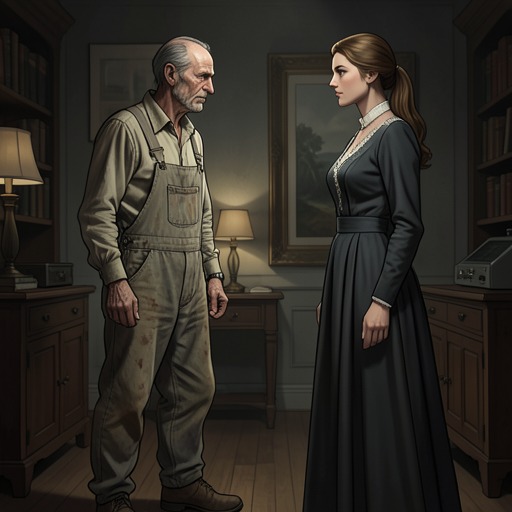
Bentley Drummle
Great ExpectationsBentley Drummle is a rich young gentleman whose inherited social standing contrasts with the moral and intellectual qualities the novel associates with genuine gentility. He is introduced as heavy, idle, proud, miserly, reserved, and suspicious; his persistence in pursuing Estella culminates in their marriage, but the narrative does not disclose what happens to their relationship afterward. Through Drummle, Pip’s story exposes the distance between social rank and character, while Mr. Jaggers’s nickname for him, the Spider, makes his patient, opportunistic pursuit a recurring image.
Identity and Introduction
Drummle joins the household of Matthew Pocket as a young man studying under his instruction. He shares a house with Pip and Startop, occupying one of the private rooms shown to Pip. His family is wealthy and comes from Somersetshire. The narrator describes them as having nurtured Drummle’s qualities until he reached adulthood and was recognized as both a blockhead and an adult. His advantages are thus established through money and family position, not through demonstrated ability.
Pip’s description emphasizes Drummle’s heaviness: his figure, movements, and understanding are all slow; his expression is sluggish, and his large tongue seems awkward in his mouth. He is idle, proud, niggardly, reserved, and suspicious. The portrait makes his manner as important as his appearance: he treats even taking up a book as though the writer had wronged him, and he does not enter into acquaintance agreeably. The characterization is pointed but not simply a catalogue of faults; his physical and social presence anticipates the persistent, unwelcome pursuit that defines his later role.
Conduct among Pip and His Companions
Drummle’s place in the group is marked by distance and antagonism. While Pip and Startop become friendly and row home alongside one another, Drummle tends to follow behind, apart from them. His reserve does not amount to quietness without consequence: he takes offense easily, especially at Startop, whose liveliness and good humor seem to him like personal affronts.
At a gathering hosted by Mr. Jaggers, Drummle sneers that the others are too free with their money. Pip answers that the criticism sits poorly with someone who had recently borrowed money from Startop. Drummle replies that Startop will be paid, then laughs at the company as though their willingness to lend proves their foolishness. Startop tries to redirect the exchange with a joke, but Drummle resents the laughter. He picks up a large glass and is about to throw it at Startop before the host seizes it. Mr. Jaggers ends the gathering by announcing the time; afterward, Startop tries to resume friendly terms, but Drummle refuses even to walk on the same side of the street. The scene shows his capacity to turn ordinary disagreement into open hostility, while also exposing the gap between his criticism of others’ spending and his own reliance on borrowed money.
The Spider and the Pursuit of Estella
Mr. Jaggers privately identifies Drummle as the Spider, describing him to Pip as the sulky, awkward young man. The nickname becomes an interpretive frame for his conduct: Drummle waits, watches, and persists rather than winning affection through warmth or mutual understanding. At the Finches of the Grove, when it is his turn to toast a woman, he chooses Estella. Pip is startled by the public declaration, and Drummle refuses to explain himself.
Drummle soon begins following Estella closely, and she permits the attention, sometimes encouraging him and sometimes discouraging him. Pip finds the situation painful, particularly because he considers Drummle contemptible and unworthy of her. At an Assembly Ball in Richmond, where Estella has outshone the other women, Drummle stays near her with her apparent tolerance. Pip raises his concern directly, telling Estella that it makes him unhappy to see her encourage a man whom people generally despise. His appeal does not alter the course of their association.
Jaggers’s metaphor stresses patience and advantage rather than merit. Drummle’s confidence in his money and family position partly compensates for his lack of concentration or determined purpose; by watching Estella doggedly, he outlasts more appealing rivals and takes opportunities when they arise. This pursuit is not presented as proof of romantic compatibility. Instead, its persistence, together with Estella’s shifting responses, leaves Pip watching a choice he cannot control.
Marriage and Mr. Jaggers’s Warning
Estella eventually tells Pip plainly that she is going to marry Drummle. Pip reacts with grief and urges her not to take what he calls a fatal step. He asks her to choose someone worthier, while acknowledging that she has already put him aside. His plea makes explicit the imbalance at the center of their relationship: Pip loves Estella, but she does not choose him, and his judgment of Drummle cannot decide her future.
After the marriage is announced, Mr. Jaggers tells Pip that the Spider has won the pool. He qualifies the apparent victory, however, by warning that Drummle may not have everything his own way. If Drummle turns to violence, Jaggers suggests, he might gain power through force; if the contest were one of intellect, Drummle would not be likely to prevail. Jaggers and Wemmick reduce the possible pattern to two alternatives: a man like Drummle either beats or cringes. These remarks are predictions, not confirmation of what takes place in the marriage. The novel offers no later scene establishing how Drummle treats Estella or how their married life ends, and his arc must therefore remain unresolved beyond the fact of their marriage.
Characterization and Narrative Significance
Drummle is chiefly defined by a consistent set of traits rather than by an interior transformation: pride, dullness, suspicion, miserliness, and persistence. The Spider image gives those traits a compact form, linking his patience in social competition to his pursuit of Estella. He is able to gain what Pip wants, not because the narrative presents him as more deserving, but because he is well placed, tenacious, and willing to wait.
His function in Pip’s story also sharpens the distinction between inherited status and moral worth. Drummle’s wealth and family standing do not make him generous or admirable, and his readiness to ridicule others’ spending is undercut by his borrowing from Startop. At the same time, Pip’s intense dislike of him is entangled with jealousy: Drummle’s success with Estella wounds Pip, even as Pip frames his objection as concern for her. The retrospective narration records both the social judgment of Drummle and the personal pain that colors it, leaving readers to see that Pip’s assessment may be accurate without being disinterested.